
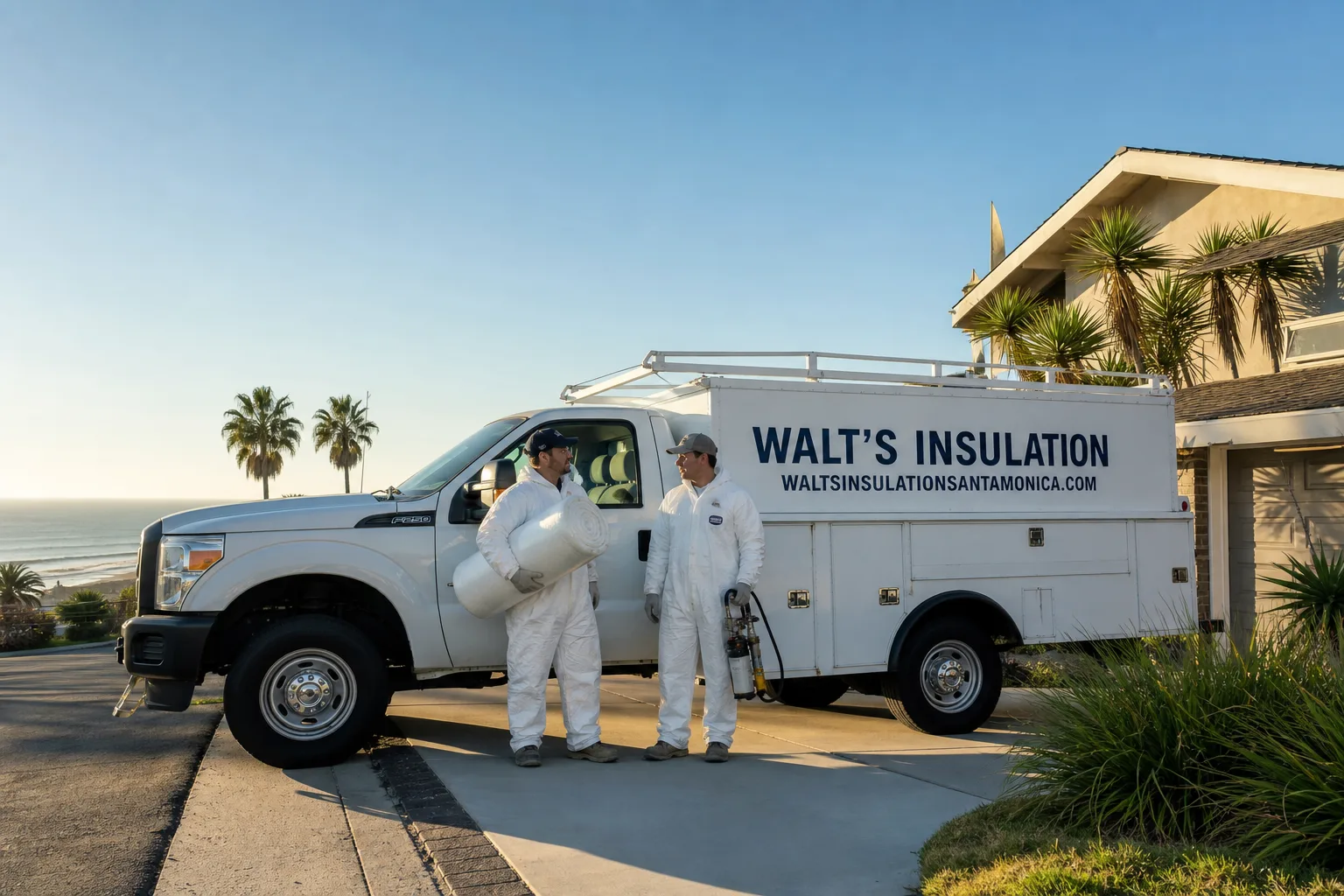
How Much Does Crawl Space Encapsulation & Vapor Barrier Cost in Santa Monica?
Crawl Space Encapsulation & Vapor Barrier services in Santa Monica typically run between $3,500 and $8,500 for most residential jobs, with a basic vapor barrier installation starting around $1,200 to $2,500. Full encapsulation – which includes a heavy-mil liner, sealed vents, drainage matting, and often a dehumidifier – lands closer to $5,000 to $12,000 for larger or more complex spaces. The wide range comes down to square footage, liner thickness, moisture damage already present, and what your specific crawl space needs to be dry and stable long term.
Crawl Space Encapsulation & Vapor Barrier Cost Breakdown (2026)
Here’s how the numbers typically break down for Santa Monica homeowners in 2026. These ranges reflect real local jobs – not national averages that don’t account for Southern California labor rates, coastal moisture conditions, or the older housing stock common in neighborhoods like Ocean Park, Sunset Park, and Mid-City.
| Service / Component | Typical Cost Range | Notes |
|---|---|---|
| Basic vapor barrier (6-mil poly sheet) | $1,200 – $2,500 | Ground cover only, no vent sealing or drainage |
| Mid-grade vapor barrier (10-12 mil liner) | $2,000 – $4,000 | Better puncture resistance, partial perimeter tape |
| Full encapsulation system (20-mil liner) | $4,500 – $8,500 | Sealed vents, taped seams, wall coverage, drainage matting |
| Encapsulation + dehumidifier unit | $6,000 – $12,000 | Recommended for spaces with active moisture or prior mold history |
| Vent sealing only | $300 – $800 | Add-on or standalone in conditioned crawl spaces |
| Drainage matting / dimple board | $500 – $1,500 | Protects liner from standing water or soil moisture wicking |
| Mold remediation (before encapsulation) | $800 – $3,000+ | Required before sealing if active mold is present |
| Old insulation removal (if needed) | $600 – $2,000 | Common in older Santa Monica homes with damaged batt insulation |
| Crawl space access door / hatch upgrade | $250 – $600 | Often needed for proper conditioned-space access |
| Post-encapsulation insulation (floor or walls) | $1,500 – $4,000 | Spray foam or rigid board for thermal performance |
For a typical Santa Monica home with a crawl space between 800 and 1,500 square feet, a full encapsulation job – liner, vent sealing, drainage matting, and a dehumidifier – runs $7,000 to $10,000 installed. Smaller, simpler jobs (a clean 500-square-foot crawl space with no moisture damage, just a liner and basic sealing) can come in at $3,500 to $5,000. Homes in Sunset Park or north of Wilshire with original 1940s-1960s construction often need more prep work before the liner ever goes down, which pushes costs toward the upper end.
One thing that consistently surprises Santa Monica homeowners: the liner itself is only part of the price. Labor in Los Angeles County runs higher than the national average, and tight or low-clearance crawl spaces add time. A crawl space with less than 18 inches of clearance takes noticeably longer to work in – that translates directly to labor cost.
What Affects Crawl Space Encapsulation & Vapor Barrier Pricing in Santa Monica
- Square footage and shape of the crawl space: Pricing typically starts at around $3 to $7 per square foot for the liner and installation combined, depending on the system. Irregular layouts, low clearance, or areas sectioned off by piers or support beams add labor time. Many Santa Monica bungalows and older Craftsman homes have crawl spaces with awkward access points that add 10-20% to the install time.
- Liner thickness and material quality: A 6-mil poly sheet is the minimum – it keeps ground moisture down but won’t hold up to foot traffic or punctures from debris. A 20-mil reinforced liner costs more upfront but is the right choice for any crawl space you or a technician will access more than occasionally. The difference between a 6-mil and 20-mil liner on the same job can be $1,500 to $2,500 in material cost alone.
- Existing moisture damage or mold: If we open the crawl space hatch and find wood rot, standing water, or visible mold growth – which is not unusual in Santa Monica homes that sit a few blocks from the coast – that work has to be addressed before encapsulation. Mold remediation alone can add $800 to $3,000 to the project. Skipping it and sealing over the problem makes it worse, not better.
- Coastal proximity and humidity levels: Santa Monica’s marine layer is not just a weather nuisance – it drives real moisture into crawl spaces year-round. Homes west of Lincoln Boulevard, particularly in North of Montana and Wilshire Montana, sit in consistent ocean air that keeps soil moisture elevated even in summer. Jobs in these areas almost always benefit from a dehumidifier, which adds $1,200 to $2,500 to the total but dramatically extends the life of the liner and the wood framing above it.
- Whether existing insulation needs to come out: Old fiberglass batts in floor joists often hold moisture once a crawl space gets wet. If that insulation is sagging, moldy, or contaminated – common in homes that haven’t had crawl space work done since the 1980s or earlier – it has to be removed before we can do proper encapsulation. Removal runs $600 to $2,000 depending on how much material is up there.
- Local permitting: The City of Santa Monica’s Building and Safety Division may require a permit for crawl space work that involves structural modifications, HVAC connections to a conditioned crawl space, or significant alterations to foundation vents. Permit fees vary, but budget $150 to $400 if your project triggers the requirement. We pull permits where required – no gray areas, no cutting corners to save a few hundred dollars on paper that can cost you thousands at resale.
- Dehumidifier installation and drainage: A good crawl space dehumidifier (Santa Fe or similar commercial-grade unit) costs $800 to $1,500 for the unit alone, plus installation. If the dehumidifier needs to drain to daylight or to a condensate pump, that adds another $200 to $600. For most Santa Monica homes west of the 405, we recommend this as part of any full encapsulation system, not an optional upgrade.
How to Save on Crawl Space Encapsulation & Vapor Barrier
The honest answer is that crawl space encapsulation is not a service where the lowest bid usually works out well. A liner that isn’t properly taped at the seams or lapped up the walls lets moisture in from the sides – which defeats the entire purpose. That said, there are real ways to get a better value without cutting corners on the work itself.
Get a second opinion on any written quote
If another contractor has already given you a written estimate, bring it to us. We offer a free second opinion on any written estimate – no trip charge inside Los Angeles County. In our experience, about 40% of the estimates Santa Monica homeowners show us are either overbuilt for the actual crawl space condition or are missing line items that will become change orders later. Either way, you deserve to know before you sign.
Ask what’s actually driving the quote
A good contractor will walk you through each line item. If a quote just says “full encapsulation – $8,000” with no breakdown, that’s a flag. Ask: what mil liner? Are vents being sealed or just taped? Does this include drainage matting? Is the dehumidifier in the price or separate? Knowing what you’re getting makes comparison easier and prevents unpleasant surprises on the final invoice.
Bundle with related work
If your crawl space insulation is also due for replacement – which is often the case in Santa Monica homes where fiberglass batts have been in place for 20-plus years – doing the insulation removal and new installation at the same time as encapsulation saves a second mobilization cost. The same goes for attic air sealing or attic insulation work. One crew, one trip, one cleanup.
Address problems early
Small moisture issues become big moisture issues in Santa Monica’s climate. A crawl space that gets encapsulated when there’s minor surface mold costs far less to remediate than one that gets ignored for two more years. We see this pattern regularly in properties near the beach – the marine air doesn’t take a break in summer the way drier inland climates do.
Take advantage of standing offers
Walt’s Insulation offers $40 off any repair over $200, a permanent 10% discount for seniors and veterans (no expiration, no hoops to jump through), and free estimates. Call (424) 396-5828 to schedule yours – whoever picks up will give you an honest read on what your crawl space actually needs before we ever give you a number.
Check for utility rebates
Southern California Edison and SoCalGas both offer rebate programs that sometimes apply to crawl space work, particularly when encapsulation is part of a broader energy efficiency upgrade. The availability changes year to year, so it’s worth asking your contractor and checking the current program offerings directly with your utility provider. We don’t promise specific rebate amounts because those programs change, but we can tell you whether your project might qualify.
Is a Vapor Barrier the Same as Encapsulation?
Not exactly – and understanding the difference helps you know what you’re actually buying.
A vapor barrier is typically a plastic sheeting laid on the ground of the crawl space to slow moisture from rising up through the soil. It’s the minimum-level moisture control. A 6-mil poly sheet costs less and does a reasonable job in mild conditions, but it doesn’t seal the walls, doesn’t close the vents, and doesn’t condition the air space.
Full encapsulation treats the crawl space like a conditioned zone. A heavy reinforced liner (16-mil to 20-mil) covers the ground and goes up the foundation walls, vents are sealed, all seams are taped, and typically a dehumidifier is added to actively manage the air humidity inside the sealed space. The result is a crawl space that stays consistently dry even in Santa Monica’s coastal humidity, which protects the floor framing, reduces energy costs by keeping conditioned air from escaping through a damp buffer zone, and prevents the musty smell that can migrate up into living areas.
For most Santa Monica homes we visit – especially anything within a mile of the ocean – we recommend full encapsulation over a basic vapor barrier. The upfront cost difference is real, but so is the difference in long-term performance. A 6-mil sheet in a coastal environment often needs to be replaced or augmented within 5 to 8 years. A properly installed encapsulation system, backed by our Done Right Promise, is built to last.
You can read more about how we approach this work on our Crawl Space Encapsulation & Vapor Barrier in Santa Monica service page.
What Santa Monica Homeowners Actually Experience in Their Crawl Spaces
We’ve been doing this work in Santa Monica and the surrounding Westside since Walt Brenner founded the company in 2000. A few patterns show up consistently enough to be worth mentioning.
In Ocean Park and the blocks south of Pico, older bungalows built in the 1940s and 1950s often have vented crawl spaces with original foundation screens that have long since corroded or partially collapsed. Moisture gets in freely, and the subfloor framing shows it – soft spots, sagging insulation, and sometimes active rot near the perimeter. These jobs usually require remediation before any liner goes down.
In Sunset Park, we see a high proportion of homes that have had partial DIY vapor barrier attempts – a roll of 6-mil poly laid on part of the floor, not taped, not lapped up the walls. It’s better than nothing, but it often creates a false sense of security while moisture continues to enter from the sides and seams. Full encapsulation fixes what the partial barrier left unaddressed.
In North of Montana and the adjacent areas of Brentwood just across the city line, homes tend to be larger, with crawl space square footage in the 1,500 to 2,500 range. These jobs cost more simply because there’s more to cover, but they also benefit most from a dehumidifier – the spaces are large enough that passive moisture control isn’t reliable.
Near Lincoln Boulevard and the Mid-City area, we encounter a mix of housing ages. Post-war construction here sometimes has crawl spaces that were retrofitted with insulation at some point, but the insulation has been compromised by rodent activity or moisture. Rodent proofing often runs parallel to encapsulation work in these areas. We handle both.
FAQs – Crawl Space Encapsulation & Vapor Barrier Cost in Santa Monica
How much does crawl space encapsulation cost in Santa Monica in 2026?
Full crawl space encapsulation in Santa Monica typically costs $4,500 to $12,000, with most homeowners paying in the $6,000 to $9,000 range for a complete system including a 20-mil liner, sealed vents, and a dehumidifier. A basic vapor barrier only (6-mil poly, no vent sealing) starts around $1,200 to $2,500. The variation is driven by square footage, crawl space condition, liner thickness, and whether remediation work is needed first. Call (424) 396-5828 for a free, itemized estimate – we’ll give you exact numbers for your specific crawl space, not a range pulled from a national database.
Is it cheaper to just install a vapor barrier instead of full encapsulation?
A basic vapor barrier costs $1,200 to $2,500 less upfront than full encapsulation, but for most Santa Monica homes – especially west of Lincoln Boulevard where the marine layer is a constant presence – a vapor barrier alone often doesn’t solve the moisture problem. It slows ground moisture but leaves the vents open and the walls unprotected. Homeowners who start with a basic vapor barrier frequently call us back within 5 to 7 years for full encapsulation anyway. If budget is tight right now, a quality mid-grade barrier (10-12 mil) is a better stopgap than a thin 6-mil sheet, and we can plan the full system in phases. Ask us about that option when you call.
Can crawl space encapsulation lower my energy bills?
Yes – and the savings are measurable. A properly encapsulated crawl space reduces the conditioned air that escapes through a damp, poorly sealed buffer zone under your floors. Santa Monica homeowners we’ve worked with report floor temperatures that feel noticeably warmer in winter and reduced HVAC run times year-round, particularly in homes with hardwood floors over the crawl space. The exact savings depend on your home’s current air sealing condition and HVAC setup, but a well-executed encapsulation combined with floor insulation can cut heat loss through the floor by 30 to 50 percent. That adds up over time in a city where you’re running heat and cooling through most of the year.
How long does crawl space encapsulation take to install?
Most residential crawl space encapsulation jobs in Santa Monica take 1 to 3 days from start to finish. A smaller, straightforward crawl space (under 800 square feet, clean and accessible) can be done in a single day. Larger spaces, those with low clearance, or jobs that require remediation or old insulation removal first typically run 2 to 3 days. We give you a realistic timeline before we start – no rushed jobs that cut corners to hit a schedule. Walt Brenner has built this business on doing the work right the first time, and that’s what the Done Right Promise means in practice.
Do I need a permit for crawl space encapsulation in Santa Monica?
Not always, but sometimes. The City of Santa Monica’s Building and Safety Division requires permits when crawl space work involves modifications to the structural system, changes to foundation vents that affect the building envelope classification, or connections to HVAC systems. A straightforward liner-and-dehumidifier installation in an existing vented crawl space typically doesn’t require a permit. We assess permit requirements for every job and pull them where needed – it’s factored into the estimate upfront, not added as a surprise at the end. Budget roughly $150 to $400 if your project does require one.
What’s the difference between a 6-mil and a 20-mil crawl space liner?
The thickness difference is significant in real-world use. A 6-mil liner is the minimum code requirement in many jurisdictions – it provides basic ground moisture control but is easy to tear during installation or when technicians need to access the crawl space later. A 20-mil reinforced liner is the professional-grade product we use for full encapsulation: it’s puncture-resistant, rated for foot traffic, holds its tape seams over time, and is specifically designed to be a long-term solution rather than a temporary barrier. The material cost difference is roughly $0.40 to $0.90 per square foot, which translates to $400 to $900 extra on a 1,000-square-foot crawl space – a cost that pays for itself in durability and reduced replacement frequency.
What happens if mold is already present in my crawl space?
Mold must be addressed before any liner goes down – sealing over active mold accelerates the problem rather than containing it. In Santa Monica, we see mold most often in homes that have had standing water intrusion, failed gutters directing water toward the foundation, or chronically damp conditions from the coastal marine layer with no ventilation to offset it. Remediation typically costs $800 to $3,000 depending on the extent and type of growth. We’ll identify it during the initial inspection and factor the remediation into the overall project scope so you’re not surprised mid-job. Our technicians are background-checked, uniformed, and experienced in crawl spaces with challenging conditions – this is not unusual work for us.
Why Santa Monica Homeowners Call Walt’s
Walt Brenner started this business in 2000 with a straightforward idea: do the work right, answer the phone when someone calls, and stand behind what you installed. That hasn’t changed in 25-plus years, even as the business has grown. We’re on the home page of a lot of Santa Monica homeowners’ searches because we’ve earned it the slow way – job by job, referral by referral.
When you call (424) 396-5828, a real person picks up – not a call center, not a voicemail. That’s true at 7 a.m. and at 9 p.m. Our technicians are background-checked and uniformed, so you know exactly who is coming through your access hatch and into your crawl space. We give you upfront pricing before we start, and we back every crawl space encapsulation job with the Done Right Promise: lifetime workmanship coverage, no runaround if something isn’t right.
We’re not the contractor who gives you the lowest number to win the job and then makes it up in change orders. We’re the one down the road – a real address, a real license number, real technicians who have been doing this work in Santa Monica for years. If you’ve already got a written estimate from another contractor, bring it. Our free second opinion costs you nothing and might tell you something useful either way.
Seniors and veterans get 10% off every job, permanently. No expiration date, no annual renewal, no minimum spend.
If your crawl space is holding moisture, showing signs of mold, has a deteriorated or absent vapor barrier, or you’re just not sure what’s going on down there, a free inspection is the right first step. We’ll tell you exactly what we find and exactly what it would cost to fix it.
Call (424) 396-5828 to schedule your free crawl space estimate. Walt’s Insulation serves Santa Monica and the surrounding Westside – and whoever picks up will give you a straight answer, not a sales pitch.
Written by Walt Brenner, Owner at Walt’s Insulation, serving Santa Monica since 2000.
Pricing reflects the Santa Monica market as of 2026. Walt’s Insulation offers free estimates – call (424) 396-5828.
What Our Customers Say
"Radiant barrier and new insulation in one visit. Walt explained what the foil actually does and what it does not, which nobody else bothered to. Electric bill in July was the lowest it has been in this house."
- Nadia Haddad"Air sealing first, then blown-in over the top. He found a bathroom fan venting straight into the attic and fixed that too. Written price before they started, same price when they finished."
- Arjun Mehta"Spray foam in the garage ceiling under the bonus room. That room used to be unusable in summer. Walt talked me out of foaming the whole attic because it did not need it - saved me a couple thousand and I trust him more for it."
- Bud Larkin